Research Point - The still life genre
To approach such a huge area of research, I have decided to study a painting from each century and note down my observations on medium, style, application and the mood of each piece.
Pieter Aertsen 'A meat stall' 1551. Oil on canvas:
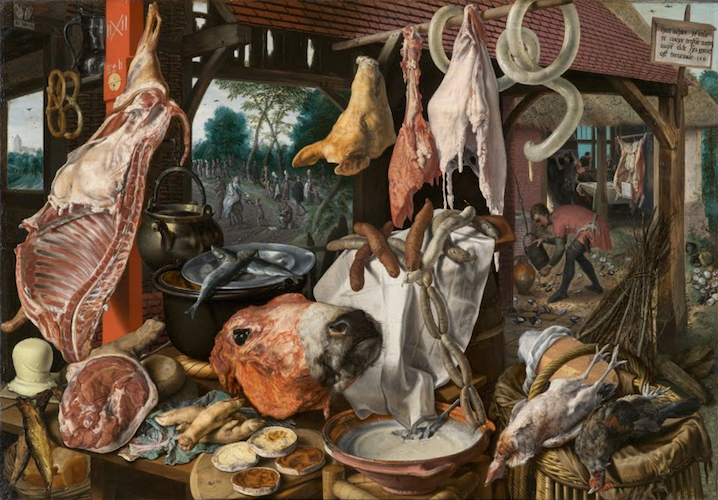
This painting offers a scene of abundance. A stall full of meat, of food. Outside of the doorway I can see many people going about their business, picking up supplies. In the immediate scene I can see fish and sausages, birds and ham and of course the most striking element, the head in the centre.
The oils are used here with such precision and skill. The colour is exact, so truthful. The scene has been depicted exactly as it would be caught on a camera in this modern age. There is no room here for an untruth. It is a photograph of the stall. A stark reality.
The shadows have been painted in so accurately on the white cloth just right of the head. In shade a pale grey. Shadows of the fish can also be seen on the large kettle pot to the left of the plate of fish.
This style of painting is traditional and precise.
Maria can Oosterwyck 'Still Life with Flowers and Butterflies' 1686. Oil on panel:

Flower paintings became a favourite in the 17th century. A celebration of horticulture.
Here I can see an explosion of colour is a large vase of flowers against a stark dark, black background. Most obvious to me are the large pink roses, so large and heavy they are weighed down by their own body. Petals have started to wilt, I can see them collecting on the side. Also in the mix I can see peonies and an Iris. I can see two butterflies delicately feeding off the flowers.
This painting is decorative and pretty. A visual delight. A fashion piece. It depicts abundance. It represents life and death. The use of colour is delicate and rich. Bright and gaudy. Each petal is readable. I can see the stems in the transparent glass vase, I don't see water there, perhaps that is why the flowers are starting to wilt.
Jean Simeon Chardin 'Pears, Walnuts and a Glass of Wine'. 1768. Oil on canvas:

In the 18th century the still life genre had become unpopular. Interest lay in political paintings with little moral value. However Chardin successfully bought attention back to simple, domestic still life objects.
Here I see precision. Three pears are accurately captured. The light bounces of the flesh, I can see this in nearly white flashes. A broken walnut sits just in front of the pears and a glass of wine just to the left had side.
The colour is really interesting here as it appears almost in the same tone, a subtle and muted brown and beige. To me I interpret these muted tones as a dark room. Although of course other colours, the green and yellow of the pears and the deep red of the wine are still distinguishable. I feel what Chardin has done here is allow the eye to see the beauty in the most simple of things again, a fashion that had been lost. He brings attention back to natural objects and has painted this still life in the most beautiful and natural way (in contrast to the decorative work of Oosterwyck).
Vincent Van Gogh 'Sunflowers' 1889. Oil of canvas.

Whilst researching this piece I found a number of canvasses. All using a single use of the colour yellow, yellow of all shades. The sunflowers are all different on each canvas. Oil on canvas, each stroke is expressive, there is such energy in the marks. The colour is thick and bold. Largely yellow however I can see a small in of blue right in the centre of the sunflower on the right hand side, such an interesting colour choice here, yet is doesn't appear out of place in any way. When I look carefully, I can also see the same hint of blue in the lower half of the vase too, this seems to add an indication of texture.
The shape of the vase doesn't seem accurate at all, yet it adds interest to the piece. Here I can see there was an appetite to capture the essence of an object, rather than an exact representation or even the beauty (such as Chardin).
The top of the vase being yellow blends in with the sunflowers, they are as one. One spirited body.
This style of painting is expressive, interesting, unreal, and energetic.
Sir William Coldstream 'Orange Tree'. 1974. Oil on canvas.

"Without much conscious selection except in the initial selection of the subject. I do not choose subjects in the first place because they strike me as exciting patterns or interesting shapes or colour. I choose them for the general interest – literary interest if you like…"
In the painting I can see that interest. A beautiful orange tree sits on a small brown table. It is not perfectly centred, as it would be if it had just been watered and positioned quickly. I can see that its home is a grand room. I can see wooden panels on the walls and a life portrait hanging on the wall. Sir Coldstream has only included a fraction of the hanging painting, I think this is so it does not steal attention away from the orange tree, it only hints of its position within the room that is home. Perhaps in this modern age where we all crave so much more than we have, a rich setting is important.
The colours are pale which makes me believe the room is light, I can see shadows that fall onto the wooden panelling on the walls. It is almost difficult to distinguish between the colours of the plant pot and the plants themselves. Almost like Van Gogh, I can see an effort to show that the plant that the pot merge together as one. The most striking marks of the piece are the small orange strokes of the fruit.
This piece shows a reality. A pale and light scene. A fruitful scene. A small snapshot of grandiose.
References:
- The National Gallery: https://www.nationalgallery.org.uk/artists/vincent-van-gogh
- http://www.bbc.co.uk/history/historic_figures/van_gogh_vincent.shtml
- The Tate Gallery https://www.tate.org.uk/art/art-terms/s/still-life
- The Royal Collection Trust: https://www.rct.uk/collection/405626/still-life-with-flowers-and-butterflies
- ''The Paintings of William Coldstream 1908-1997' by William Coldstream
- 'The Art of Still Life' by Todd M Casey


Comments
Post a Comment